
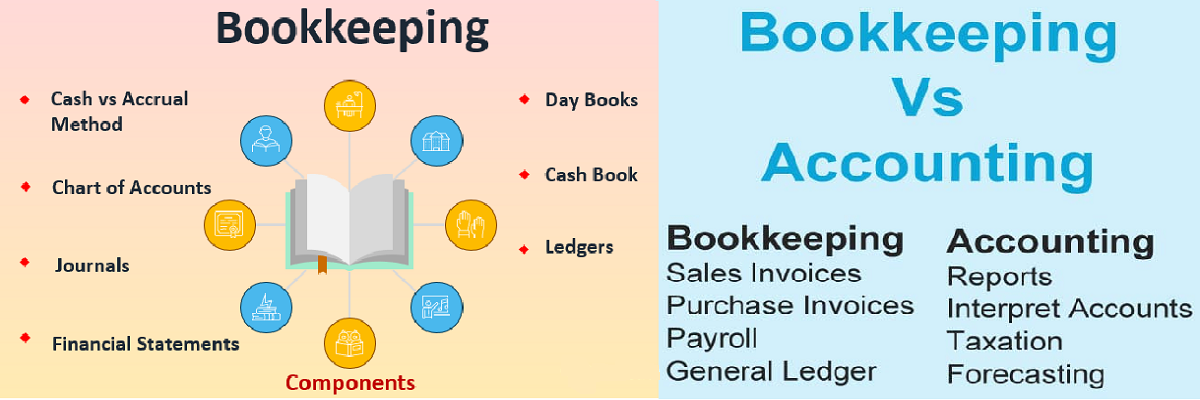
What Is Bookkeeping?
Bookkeeping records financial transactions in business and forms the foundation of accounting. These transactions include purchases, sales, receipts, and payments made by an individual or a business entity. Bookkeepers typically follow either the single-entry or double-entry bookkeeping system. Regardless of the method, if you record financial transactions, you’re practicing bookkeeping.
Role of a Bookkeeper
A bookkeeper handles daily financial transactions, documenting them in daybooks such as purchase, sales, receipts, and payment records. Bookkeepers ensure accurate entries in supplier ledgers, customer ledgers, and general ledgers. Accountants then use this data to prepare financial reports.
Bookkeepers also prepare the trial balance, allowing accountants to create income statements and balance sheets.
History of Bookkeeping
In colonial America, businesses used a “waste book” to record daily transactions, including receipts and expenditures. Once they transferred the information to a daybook or ledger, they discarded the wastebook—hence the name.
Bookkeeping Process Explained
The bookkeeping process captures the financial impact of each transaction. In manual systems, a delay often exists between recording and posting, which is eliminated by modern electronic systems. To track transactions immediately, businesses use various books, including the Cash Book, Bank Book, Purchase Book, and Sales Book.
Every business transaction generates a source document, such as an invoice, receipt, or check. Bookkeepers first record these details in multi-column journals (books of first entry). Then, they post journal totals to the ledger, ensuring accounts stay balanced using the double-entry system.
From Journal to Trial Balance
Bookkeepers post journal summaries to ledgers on a monthly basis. Using the double-entry method, they debit and credit the appropriate accounts. After posting, they create an unadjusted trial balance to ensure accuracy. If the debit and credit totals don’t match, bookkeepers identify and correct the errors before proceeding.
Adjusting the Books
Once balances match, accountants adjust entries—for instance, updating inventory or applying depreciation—while still following the double-entry rules. This produces the adjusted trial balance, which forms the basis for the company’s financial statements.
Financial Statements
From the adjusted trial balance, businesses prepare key financial statements:
-
Income Statement (Profit and Loss Statement)
-
Balance Sheet (Statement of Financial Position)
-
Cash Flow Statement
-
Statement of Changes in Equity
Entry Systems in Bookkeeping
Single-Entry Bookkeeping
This system records each transaction once, focusing on income and expenses. It’s ideal for small businesses and personal finances. Most people using personal finance software follow this method.
Double-Entry Bookkeeping
This method requires at least two entries per transaction—a debit and a credit. Businesses use this system to maintain accuracy across assets, liabilities, equity, revenue, and expenses.
Types of Day Books
Bookkeepers use various daybooks to record daily financial activities:
-
Sales Day Book: Records sales invoices
-
Sales Credit Day Book: Tracks sales credit notes
-
Purchases Day Book: Captures purchase invoices
-
Purchases Debit Day Book: Notes purchase debit entries
-
Cash Day Book: Logs all cash inflows and outflows
-
General Journal: Records journal entries not covered in other books
Petty Cash Book
A petty cashier maintains the petty cash book, managing small-value purchases. Senior cashiers periodically replenish this fund once the petty cashier explains how the funds were spent.
Journals
A journal provides a chronological record of transactions before they are transferred to the general ledger. Businesses may maintain a general journal or specialized journals, such as sales, purchases, and receipts journals.
Ledgers
Ledgers summarize data from journals and include three main types:
-
Sales Ledger: Tracks customer payments (Accounts Receivable)
-
Purchase Ledger: Records purchases (Accounts Payable)
-
General Ledger: Centralizes all account data for financial statements
Common Bookkeeping Abbreviations
| Abbreviation | Meaning |
|---|---|
| A/R | Accounts Receivable |
| A/P | Accounts Payable |
| B/S | Balance Sheet |
| Dr | Debit |
| Cr | Credit |
| G/L | General Ledger |
| PL or I/S | Profit and Loss/Income Statement |
| TB | Trial Balance |
| VAT | Value Added Tax |
| EBITDA | Earnings Before Interest, Taxes, Depreciation & Amortization |
| EAT | Earnings After Tax |
Chart of Accounts
A chart of accounts lists account codes used to classify transactions in the ledger. Depending on the business type—sole proprietorship, partnership, trust, or company—this chart varies.
Computerized Bookkeeping
Modern businesses use accounting software to replace paper-based records. These systems still adhere to double-entry rules but automate posting, minimize human error, and enhance efficiency.